
Professional Machine Wiring and Control Circuit Installation Guide
Machine wiring and control circuit installation sit at the foundation of every reliable industrial facility. When electrical systems are designed and installed with precision, machines run without interruption, workers stay safe, and production schedules hold. When they are not, the consequences ripple across the entire operation, from unplanned downtime to costly equipment failures and serious safety incidents.
The demand for skilled electrical work in industrial settings has grown alongside the increasing complexity of modern machinery. Automation, programmable logic controllers, variable frequency drives, and multi-axis control systems have replaced the simpler panel layouts of previous decades. Understanding how to wire these systems correctly, follow applicable codes, and verify installation quality before energizing is no longer optional. It is the baseline expectation for any contractor or in-house electrician working in a manufacturing or heavy industrial environment.
Understanding the Scope Before You Start
Reading Electrical Schematics and Wiring Diagrams
Every machine wiring project begins with the documentation. Ladder logic diagrams, one-line drawings, and wiring schematics tell you what components exist, how they connect, and what the control sequence is supposed to do. Before touching a single conductor, we review all available documentation, identify discrepancies between the drawing set and the actual equipment, and request updated prints when none exist.
Industrial schematics use standardized symbols from NEMA and IEC conventions. Knowing the difference between normally open and normally closed contacts, understanding relay logic, and reading terminal block labels accurately prevents wiring errors before the work begins.
Site Assessment and Load Calculations
We assess the physical environment before laying out conduit routes or pulling wire. This includes identifying existing panel capacity, confirming that the disconnect means are properly rated for the machine, and calculating the full load amperage of all motors and control devices. Undersizing conductors or overcrowding panels are two of the most common field mistakes, and both create heat buildup that degrades insulation over time.
Control Circuit Fundamentals
How Control Circuits Differ from Power Circuits
Power circuits carry the voltage and current that drive motors and heating elements. Control circuits govern when and how those power circuits operate. In most industrial machines, the control voltage is stepped down to 120V or 24VDC using a control transformer, which isolates the control logic from the line voltage and reduces shock hazard for technicians making adjustments during operation.
Understanding this separation matters during troubleshooting. A fault in the control circuit will prevent a machine from starting even if the power circuit is intact and properly wired.
Relay Logic and Contactor Wiring
Contactors are the workhorses of motor control. We wire them with the correct coil voltage, verify the auxiliary contact configuration, and always size the overload relay to the nameplate full load amps of the motor being controlled. A contactor that chatters during operation typically indicates low control voltage, a failing coil, or excessive voltage drop in the control wiring.
Relay logic interlocks are used to prevent conflicting operations, such as forward and reverse contactors energizing simultaneously. These interlocks must be wired in hardware even when software-based PLC logic is present, because a PLC fault should not be the only thing preventing a machine from damaging itself.
Conduit Installation and Wire Routing
Conduit Fill, Bend Radius, and Separation
NEC Chapter 3 governs raceway installation, and the fill tables exist for a reason. Overfilling conduit makes pulling wire difficult and generates heat in service. We plan conduit routes in advance, calculate fill percentages for every run, and use pulling lubricant on longer pulls to protect insulation.
Power conductors and low-voltage signal cables, such as encoder wires and analog inputs, should run in separate conduits whenever possible. Electromagnetic interference from variable frequency drives is a real problem in automated systems, and it causes signal noise that produces erratic behavior in sensors and controllers.
Panel Layout and Wire Management
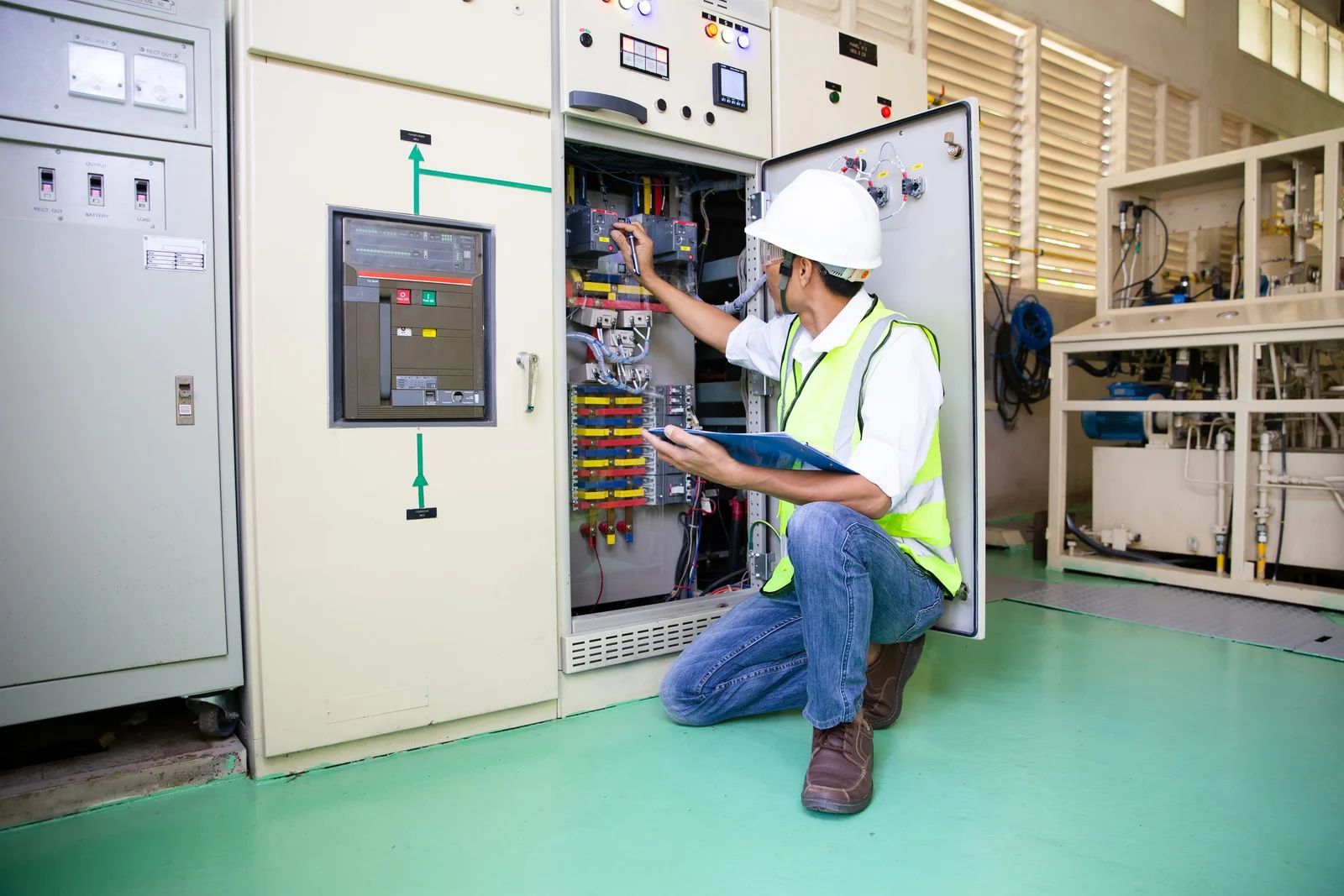
A clean panel is a maintainable panel. We route conductors along defined pathways using wire duct, label every wire at both ends with durable heat-shrink labels, and leave adequate space for future additions. Wiring that is bundled without structure or pulled tight across sharp edges will fail prematurely and create unnecessary troubleshooting time for the next technician.
Terminal blocks should be grouped logically, input signals on one rail and output signals on another, so that field wiring can be traced without following individual conductors across the entire enclosure.
PLC Integration and Field Device Wiring
Wiring Discrete Inputs and Outputs
Programmable logic controllers require precise wiring of their I/O modules. Discrete inputs connect to limit switches, proximity sensors, push buttons, and safety devices. Each input has a common reference, and polarity matters on DC I/O modules. Wiring a sinking input to a sourcing module, or vice versa, is a common error that produces inputs that never read correctly.
Discrete outputs drive contactors, solenoid valves, indicator lights, and other loads. Output modules have current ratings that must not be exceeded. When the load exceeds the module's capacity, we install interposing relays to protect the PLC while still allowing control of high-current devices.
Analog Signal Wiring and Shielding
Analog signals, typically 4-20mA current loops or 0-10V voltage signals, require careful attention to shielding and grounding. We use shielded cable, ground the shield at one end only to avoid ground loops, and run analog wiring away from noise sources. An improperly grounded shield can introduce more noise than it removes, which results in unstable readings and erratic process control.
Safety Systems and Code Compliance
Emergency Stop Circuit Design
Emergency stop circuits must be wired to a safety relay or safety PLC, not to a standard control relay. Safety relays monitor the integrity of the E-stop loop and will not allow the machine to restart if a wire is broken or a contact has failed. This is a requirement under NFPA 79 for industrial machinery, and it is not a detail that can be skipped to save time or material cost.
We wire E-stop buttons in series, verify that each button is a normally closed contact type, and test the circuit for proper operation before commissioning. A machine that passes a safety circuit test before startup is one where the operator can trust the emergency stop to function when it matters.
NEC and NFPA 79 Compliance
The National Electrical Code sets minimum standards for conductor sizing, raceway fill, grounding, and overcurrent protection. NFPA 79, the Electrical Standard for Industrial Machinery, adds requirements specific to machine tool wiring, including rules for control panel construction, conductor color coding, and the location of disconnecting means.
We pull permits where required, coordinate inspections, and document our installations with accurate as-built drawings. Compliance is not a formality. It is what separates an installation that will pass inspection and perform reliably from one that creates liability for the facility owner.
NEC and NFPA 79 Compliance
The National Electrical Code sets minimum standards for conductor sizing, raceway fill, grounding, and overcurrent protection. NFPA 79, the Electrical Standard for Industrial Machinery, adds requirements specific to machine tool wiring, including rules for control panel construction, conductor color coding, and the location of disconnecting means.
We pull permits where required, coordinate inspections, and document our installations with accurate as-built drawings. Compliance is not a formality. It is what separates an installation that will pass inspection and perform reliably from one that creates liability for the facility owner.
Experienced Electrical Contractors Beaumont Facilities Have Relied On
Professional machine wiring and control circuit installation require more than the ability to follow a diagram. They demand a working knowledge of electrical theory, code compliance, system integration, and real-world troubleshooting. Getting these installations right protects equipment, protects personnel, and protects the productivity of the facility that depends on these systems running without failure. The sections above outline the core disciplines that separate a sound installation from one that creates problems down the line. As facilities modernize and control systems grow more complex, the value of experienced electrical contractors who understand both the craft and the engineering behind it will only increase.
A&A Electric Company Of Beaumont has served the Beaumont, Texas area for 40 years, building a reputation on precise electrical work across commercial, industrial, and machine installation projects. We bring hands-on expertise to every machine wiring and control circuit job we take on, from initial site assessment through final commissioning and documentation.
Our background in industrial electrical contracting means we understand the demands of production environments where downtime is expensive and safety is non-negotiable. We work to code, wire with care, and deliver installations that hold up under the conditions of daily industrial use. Whether a facility needs a complete control panel build, a PLC integration project, or a full machine wiring installation, our crew approaches every job with the discipline that years of fieldwork has built into our process. Facilities in and around Beaumont, Texas trust us with their most critical electrical systems, and we take that responsibility seriously in everything we do.
Frequently Asked Questions
What is the difference between a control circuit and a power circuit in industrial machinery?
A power circuit delivers voltage and current to motors and loads. A control circuit governs the logic that starts, stops, and sequences those loads, usually at a lower and safer voltage than the main power supply.
Why do we use a separate control transformer in machine wiring?
A control transformer steps line voltage down to a safer level for control devices and isolates the control circuit from the power circuit, which reduces shock hazard and protects sensitive components from voltage fluctuations on the line side.
What causes an emergency stop circuit to fail to reset after a fault?
Most E-stop reset failures come from a broken wire in the safety loop, a failed contact in one of the stop buttons, or a safety relay that has detected a fault condition and requires a manual reset procedure before it will allow the machine to restart.
How do we prevent signal noise from affecting PLC analog inputs?
We use shielded cable with the shield grounded at one end only, route analog wiring separately from power conductors, and keep signal cables away from VFD output lines, which are among the strongest sources of electromagnetic interference in a typical machine installation.
Is a permit required for machine wiring and control circuit work?
Permit requirements vary by jurisdiction and project scope. In most areas, installing new electrical systems or making significant modifications to existing ones requires a permit and inspection. We always verify local requirements before starting work and pull permits where they are required.